A defender of the linguistic, cultural, and territorial rights of the Métis in the face of Canadian expansionism
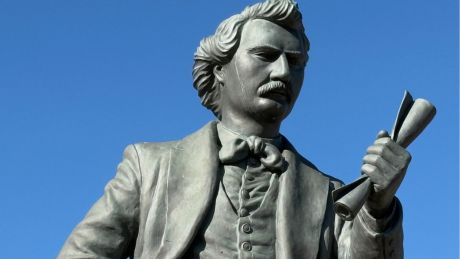 Photo credit: Stephan Hardy. Statue of Louis Riel on the grounds
of the Manitoba Legislative Assembly.
Métis throughout Canada consider Louis Riel a hero for his efforts to oppose colonization and preserve their rights as Indigenous people.
Upbringing in the Red River Settlement and early years
Louis Riel was born in 1844 in St-Boniface, Red River Settlement (now Winnipeg). Raised in a French-speaking Métis community at the confluence of the Red and Seine rivers, he was the eldest son of Julie Lagimodière and Métis leader Jean-Louis Riel, a businessman and political leader who succeeded in organizing a large resistance to the Hudson Bay Company (HBC)’s fur trading monopoly in 1849.1
Resisting annexation and asserting Métis rights
Jean-Louis Riel's activism undoubtably influenced his son, who was sent to Montreal to pursue his education. When Riel returned to Red River in 1868, the Métis were facing annexation by Canada. In response, he mounted a resistance, first by blocking Canadian land surveyors and then achieving consensus amongst a majority of French and English Métis to establish a provisional government.2 Riel argued persuasively that he didn’t oppose the British Crown – only the transfer of lands to the Canadian government without the consent or recognition of the rights of the Métis who lived on them.3
Riel’s efforts culminated in a Bill of Rights, embodied in the Manitoba Act, which received royal assent on May 12, 1870. The agreement with Ottawa included provisions to reserve 1.4 million acres (566,560 hectares) of land for the children of Métis residents, provide amnesty to members of the provisional government4, and ensure the province would be officially bilingual5 — a reflection of the roughly equal distribution of francophone and anglophone Métis at the time.6
A reign of terror, exile, and surrender
 Photo credit: Joel Ross, used with permission. Elzéar Goulet Memorial Park in Saint-Boniface
(MB). Elzéar Goulet, a member of Riel’s provisional government, was stoned then drowned
trying to escape Wolsely's soldiers during the “Reign of terror”.
Attempts by Métis to assume roles in the government of the new province were mostly thwarted. Worse yet, a few months later Prime Minister John A. MacDonald6 authorized Colonel Garnet Wolsely and a group of 700 militia7 to undertake an “errand of peace”8 to Upper Fort Garry – seat of the Dominion Lands Office, the first provincial legislature, and its administrative offices in the Red River Settlement – marking the start of a “reign of terror” that saw Métis9 and others10 suffer “assaults, rapes, murders, and arson”11 at the hands of British and Ontarian12 troops
Many Métis fled, including Louis Riel, who despite being elected three times to the Canadian Parliament, spent many years in exile before accepting to lead a coalition of Saskatchewan Métis and First Nations during the Northwest Resistance.13 After defeat at the Battle of Batoche, he surrendered to Canadian troops.
In the ensuing years, both the federal parliament and Manitoba's growing white, Anglo-Protestant majority enacted unlawful legislation and pursued policies14 that systematically undermined the Métis and their rights enshrined in the hard-won Manitoba Act.15
Commemorating Louis Riel and his legacy
Facing encroachment and annexation by the Canadian government, the visionary Indigenous leader was found guilty of treason and executed in Regina on November 16, 1885 for defending Métis rights, territory, languages, religion, culture, and way of life. For Métis communities throughout Canada, the anniversary of the death of Louis Riel is thus an important day of commemoration. Activities planned for the November 16th anniversary include proclamations, flag-raisings, wreath-laying, processions, religious ceremonies, cultural programming, as well as events intended to educate all Canadians about Métis history, rights, and resilience.
A selection of anniversary activities